The Inside Scoop: Soft Serve FAQs
Everything you wanted to know about Soft Serve.
Got questions about your soft serve? From product details to machine operation and settings, our FAQ page has practical, chef-to-chef answers to help you serve perfect soft ice every time.
What is the advantage of using vegetable oil instead of full dairy fat?
Vegetable oils help achieve a smooth, creamy texture and are often more cost-effective than full dairy fat.
Why does our Slower Melt soft serve melt slower?
Our unique fat and stabilizer system, developed by Arla® Foods, ensures a slower, more controlled melt.
How does UHT processing affect my soft serve mix?
UHT treatment extends shelf life and allows for ambient storage. All Arla® Pro soft serve mixes are UHT treated for convenience and reliability.
What is the difference between a soft serve and a milkshake base?
The difference lies in stabilizers and emulsifiers:
- Soft Serve Base: Balanced to maintain structure and prevent ice crystal formation.
- Milkshake Base: Adjusted for a smooth, drinkable texture.
Can I add flavors to my soft serve?
Yes. Flavours can be added via machines with automatic blending or syrup dispensers, or mixed into the base before pouring. Use syrups specifically designed for soft serve or ice cream, avoiding particles that could clog equipment.
What does overrun mean?
Overrun is the amount of air incorporated into the soft serve mix. For example, 60% overrun means 1 litre of mix produces 1.6 litres of finished soft serve.
What is pasteurization of soft serve?
Pasteurization involves heating the mix to a specific temperature for a set time to eliminate harmful bacteria. This is especially important if the mix has been in the machine for a while, ensuring it remains safe to serve.
How can pasteurization affect my soft serve?
It can influence flavour, colour, consistency, and texture. Arla® Pro soft serve mixes are tested to perform consistently through up to three pasteurization cycles.
What is the difference between a gravity-fed and pump-fed soft serve machine?
The main difference is how the mix enters the freezing cylinder:
- Gravity-fed machines: Gravity pulls the mix through a feed tube into the freezing cylinder.
- Pump-fed machines: A pump moves the mix from the hopper into the freezing cylinder.
What are the main benefits of a pump-fed machine?
- Can achieve up to 60% overrun (gravity-fed machines typically operate at 30%)
- Better control of air incorporation
Are there additional benefits of a pump-fed machine?
Yes. Pump-fed machines deliver more consistent texture and flavour, essential for customer satisfaction. They also produce high volumes quickly, making them ideal for businesses with high customer demand.
What are the downsides of a pump-fed machine?
Pump-fed machines have a higher initial cost, spare parts can be more expensive, they have more moving parts making maintenance more complex, and they require more frequent cleaning.
What are the benefits of a gravity-fed machine?
Gravity-fed machines are usually smaller, take up less space, use less energy, and require less cleaning. They are often more cost-effective for smaller setups.
What are the downsides of a gravity-fed machine?
Gravity-fed machines may struggle to maintain consistent product texture and flavour, and they operate at a slower rate compared to pump-fed machines, which can be a challenge during high customer traffic.
What is the difference between a water-cooled and an air-cooled soft serve machine?
- Water-cooled machines: Require a water inlet and outlet, less portable, deliver the best product quality and highest output per hour.
- Air-cooled machines: More portable, easier to set up, but may not match water-cooled machines in quality and output; they are also noisier and generate more heat.
FYI: Both pump-fed and gravity-fed machines can come as water- or air-cooled versions.
Which machine should I choose?
It depends on your business needs:
- Small businesses looking for an affordable, reliable machine that doesn’t need high speed can choose a gravity-fed machine.
- If speed, consistency, and higher overrun are critical, a pump-fed machine is likely the better choice.
How can I adjust the temperature in a soft serve machine to enhance flavour and suit other applications?
- Decrease temperature: Produces a firmer, denser product. A colder soft serve will have less pronounced flavour notes.
- Increase temperature: Produces a softer, creamier product. A warmer soft serve will have more pronounced flavour notes.
How can I adjust overrun in a soft serve machine to enhance flavour and suit other applications?
- Increase overrun: Adding more air creates a lighter, fluffier texture with a slower melt. The flavour will be lighter—for example, increasing overrun can make vanilla taste less intense.
- Decrease overrun: Less air produces a denser, creamier product with a faster melt and more intense flavours.
Why is my soft serve too icy?
Several factors can cause icy soft serve:
- Overfrozen mix: Leaving product in the freezing cylinder too long can cause iciness. Pull some product out to bring in fresh mix from the hopper.
- Scraper blades: Worn blades may not properly scrape the cylinder walls, leading to larger ice crystals.
- Air incorporation: Blocked or malfunctioning air tubes/pumps reduce air in the mix, resulting in a denser, icier texture.
- Overrun settings: Excessive air can affect consistency. Adjust overrun settings to achieve the ideal texture.
Why is my soft serve too grainy?
Graininess can come from lactose, air, or ice crystals:
- Lactose crystals: Poor mixing or storage can cause lactose to crystallize, forming small hard particles.
- Air bubbles: Too many or unevenly distributed bubbles can create a grainy texture.
- Ice crystals: Improper freezing or storage at too high a temperature allows large ice crystals to form, giving a gritty sensation.
Why is my soft serve melting too fast?
Several factors can cause rapid melting:
- Temperature settings: Ensure the machine is at the correct temperature; too warm will make soft serve melt quickly.
- Overrun issues: Too little air in the mix can lead to a faster melt. Increasing overrun may help.
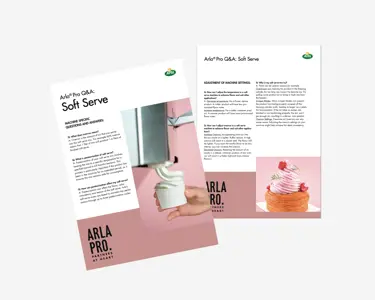
Download the FAQ cheat sheet
Download our FAQs for practical insights and quick answers to help you get the best out of Arla Pro.
Download FAQ cheat sheet